Wednesday, 6 April 2016
Did Alexander deserve to be called 'Great'? - The Oppostiton
Great can be defined as 'one who is highly skilled in a particular area'. However, shown by Alexander's apparent vanity and recklessness, one can argue that the ancient ruler is undeserving of this widely-accepted title.
'Highly skilled' is, in most cases, a very apt way of describing Alexander as a general and commander. He never lost a battle, and maximised the use of complex battle tactics to ensure his army were never defeated by the Persian enemy (the fact that our most useful sources were Greek accounts by people such as Ptolemy who would have wanted to extol Macedonian glory is very important in considering the reliability of these accounts.) Although, there are many examples of Alexander, in a spurr of the moment attack, fueled by the heat of battle, breaking from his position among his men as a commander and going after King Darius himself. This shows Alexander as being not only impulsive, but also selfish and inconsiderate of the needs of his army. Fortunately, his trusted adviser Parmenio was able to command effectively many elements of battle, and even offered Alexander potentially useful advice which the king chose to ignore. We see another example of this in Arrian's Anabasis of Alexander, in which Arrian recounts that Parmenio suggested to Alexander that they attack Darius' forces in a surprise attack at night, to give them an guaranteed advantage. However, Alexander declined this advice, claiming that he 'did not want to steal his victory'. Perhaps this gives us an indication of how much Alexander cared about his image, and how vanity remained a recurring characteristic of Alexander throughout his life.
When Alexander's Policy of Fusion was implemented, his image became all the more important. The Policy included the introduction of proskynesis (obeisance). In Persia, citizens presented before the king were expected to prostrate themselves on the floor; an act of upmost respect that is reserved only for he Gods in Alexander's native Macedonian culture. Regardless of his army's traditional customs, Alexander insisted that his companions should greet their king in this way. It could be said that Alexander was merely acquiescing to the customs of his new kingdom in an effort to assimilate the new peoples (also achieved by Macedonian nobles marrying Persian women at Susa and wearing Persian dress). However, considering the fact that Alexander truly believed he was the son of Ammon, it would not be incorrect to assume that Alexander saw himself as a god, and believed he was worthy of the honour of proskynesis.
Alexander's brutality should also be addressed when assessing how 'great' he really was. For example, when he captured Persopolis, Alexander razed the Persian royal palace to the ground, against the opinions of his adviors and perhaps unnecessarily. Even Arrian who, throughout his book and notably in the Preface seems to see Alexander as almost god-like, commented on the matter: 'I myself share the view that there was no sense in this action of Alexander's, and it could hardly constitute punishment of trhe Persians in a distant past'. Actions like this should not be seen as necessary, as actions that were taken by Philip upon capturing cities (forging alliances) could be seen as far more effective and kind than Alexander's actions. When he sacked Thebes, Alexander killed all the men and sold all the women and children into slavery. Diodorus Sicculus commented: 'All the city was pillaged. Everywhere boys and girls were dragged into captivity as they wailed piteously the names of their mothers'. Hardly a 'necessary' task considering a huge number of these citizens could have surrendered to his rule without question.
Although brutal to captured enemies, it is clear that even his closest companions were victims of his spasmodic ferocity. Upon learning of the assassination conspiracy of Philotas, the son of Parmenio, Alexander had Philotas put to death. To avoid an rebellion, Alexander also put Parmenio to death without a trial. Parmenio had been an important general of Philip's before Alexander came to the throne, and perhaps was seen as more consistently reliable than Alexander, especially in battle where his leadership of the left wing of the Macedonian army undoubtedly helped Alexander to victory. Also, at one of many drinking parties held by the king and his companions, when one companion, Cleitus, dared to speak out against Alexander, Alexander killed him with a spear. It is said that Alexander mourned profusely after his friend's death, however this shows, in some ways, how he may not have been completely stable emotionally.
A vast majority of Alexander's military achievements could not have happened without Philip's weaponry innovations. If not for his premature death, could Philip have achieved everything Alexander did, yet in a more merciful, diplomatic way? It is impossible to know what the outcome of Alexander's predecessor's reign could have been, but we could say that Alexander, being as fiersome and unpredictable as we have seen, did not deserved the title of 'Great' that was bestowed on him after his death.


.jpg)
Was Alexander Truly Great? - Pro Great Argument
Firstly we must define what being 'great' really is. The definition of 'great' is 'of ability, quality or eminence considerably above average'. Looking at this, it can be said that despite being tyrannical and brutal, it is still possible for Alexander to be great. He created new and successful military tactics, showing above average intelligence in order to come up with his ideas and was very famous in his time as well as now. He united the world and brought previous Greek and Persian enemies together, uniting them through new culture and language. He also let places keep their religions and leaders, preventing further battles and bloodshed over such matters. This also kept the peace since the leader kept his power and didn't become a puppet of Alexander which may have led to rebellions. With these places united, they could begin to help and support each other through a large trade system, distributing resources accross the world. His cruelty and brutality was a necessary part of the task he had set out to do and the outcome of peace throughout the world surely outweighs the losses made in the process of uniting Persia and Greece for example. This is also needed to show his military strength and establish himself as a good leader. Furthermore, Alexander also shows much mercy, by letting surrendering towns live on in peace and it is also shown in his kiind treatment of Darius' wife.
Ultimately, although Alexander was cruel and a tyrannt, he still excelled in many matters such as leadership and military tactics, making him fulfill the requirements to be defined as Great.
Ultimately, although Alexander was cruel and a tyrannt, he still excelled in many matters such as leadership and military tactics, making him fulfill the requirements to be defined as Great.
Alexander the Great debate - Did Alexander deserve to be called Great?
- How do we define 'Greatness'? Did Alexander meet these criteria?
- Is 'Greatness' in any way reliant on morals? Can a person who is 'great' also legitimately be a tyrant? Was Alexander a tyrant?
- Can we judge the morality of a historical figure? Morality changes over time...
- Should Alexander's 'Greatness' actually be credited to his father, Philip?
- Alexander's achievements - unifying Greece, having a city named after him, his fight against the Persians - can these be used to define him as Great?
- Is Alexander only great because our sources are often in his favour? Would he be considered 'Great' if viewed from all perspectives?
- Alexander became King by the age of 20...his personal achievements make him great. By the age of 33, he had conquered much of the world. Or is Alexander's age irrelevant? Was he always destined to be king...is it therefore not an achievement which can influence our judgement of his Greatness?
- Does Alexander's relationship with Aristotle help to define him as Great? Was Alexander's relationship with Aristotle still strong as an adult?
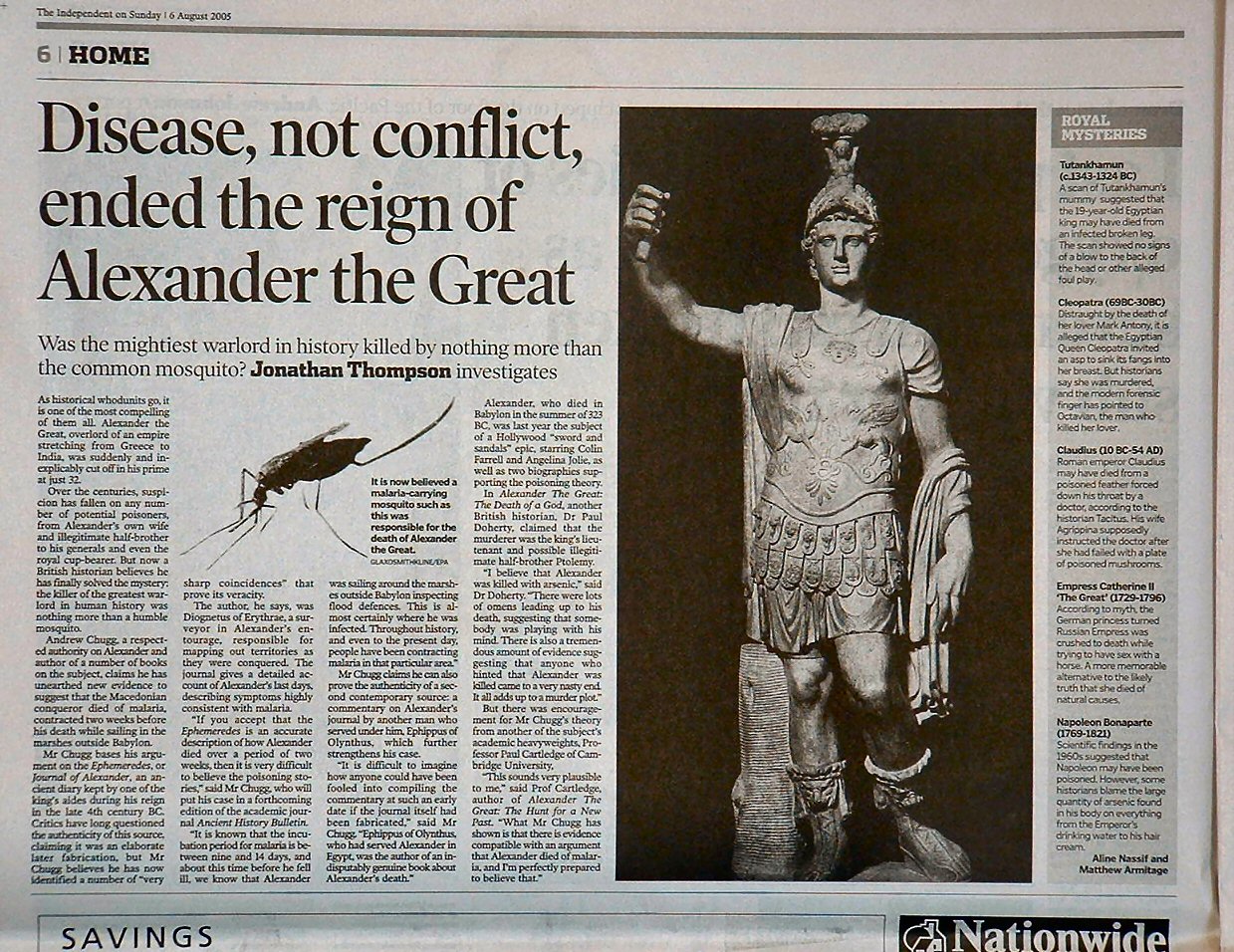
- Did Alexander's companions encourage his use of alcohol with the aim of quickening his death? Did he have unquestioned loyalty from his companions or quiet deceit? Does this have a bearing on his Greatness when viewed through our definitions of what it means to be Great?
- How do we define 'Greatness'? Did Alexander meet these criteria?
- Is 'Greatness' in any way reliant on morals? Can a person who is 'great' also legitimately be a tyrant? Was Alexander a tyrant?
- Can we judge the morality of a historical figure? Morality changes over time...
- Should Alexander's 'Greatness' actually be credited to his father, Philip?
- Alexander's achievements - unifying Greece, having a city named after him, his fight against the Persians - can these be used to define him as Great?
- Is Alexander only great because our sources are often in his favour? Would he be considered 'Great' if viewed from all perspectives?
- Alexander became King by the age of 20...his personal achievements make him great. By the age of 33, he had conquered much of the world. Or is Alexander's age irrelevant? Was he always destined to be king...is it therefore not an achievement which can influence our judgement of his Greatness?
- Does Alexander's relationship with Aristotle help to define him as Great? Was Alexander's relationship with Aristotle still strong as an adult?
- Did Alexander's companions encourage his use of alcohol with the aim of quickening his death? Did he have unquestioned loyalty from his companions or quiet deceit? Does this have a bearing on his Greatness when viewed through our definitions of what it means to be Great?
Alexander the Great Holiday History Camp April 2016 Participants

Alexander the Great Holiday History Camp
April 2016 Participants
Subscribe to:
Posts (Atom)